Refinancing is one of the most discussed financial strategies in Australia in 2026, yet it is also one of the most misunderstood. Done well, it may reduce interest costs significantly over time. Done poorly, it can quietly reset your loan into a worse long-term position. The difference between the two outcomes is not luck. It comes down to understanding when refinancing works, when it doesn’t, and which common traps cost borrowers the most. At Safe Haven Finance, Payal Varma has helped borrowers navigate refinancing decisions for close to 20 years. This guide explains the key considerations borrowers may want to assess before refinancing a home loan in 2026.
The Loyalty Tax: Why the Question Matters in 2026
Australian lenders consistently offer their most competitive rates to new customers, not to borrowers who have stayed for years. This pricing drift, commonly called the ‘loyalty tax’, is not a deliberate penalty. It is simply how lender pricing frameworks evolve. Long-term borrowers, unless they actively request a review or refinance, remain on older rates that may no longer reflect current market competition.
On a $900,000 loan, a 0.5% rate reduction can reduce interest costs by roughly $4,500 in the first year. That is not a marginal gain; it is money that currently flows to the lender instead of staying with the borrower. The question is not whether older borrowers can end up paying more. They can. The question is whether your specific situation makes refinancing the right response to it.
Also Read: Interest Rates in Australia 2026: How They Impact Your Home Loan
When Refinancing Saves You Money
- Your rate is 0.5% or more above the current market rate
This is often a common trigger for borrowers reviewing their home loans. At the time of writing, competitive variable home loan rates in Australia are sitting in the low 5% range, depending on the lender and borrower profile. Borrowers sitting well above 6.5% may want to consider whether their current loan remains competitive. On a $500,000 loan, a 1% rate reduction saves roughly $350 per month, per the Canberra Times’ January 2026 lending analysis. The switching costs of$500–$2,000 are typically recovered within weeks to a few months, well ahead of any reasonable ownership horizon.
- Your LVR, income, or property value has improved
Borrowers whose loan-to-value ratio has improved either through repayments or property growth may qualify for a better rate tier than when they first applied. Lenders actively reprice for borrowers whose LVR has moved below 80%, 70%, or 60%. If your income has also grown, the combination often delivers a meaningfully lower rate than what your current lender is offering on your existing product.
- Your fixed-rate term has just expired
The moment a fixed term ends is the strongest window to compare the market. You have no break costs, full flexibility to move, and the lender’s revert rate, which you roll onto automatically, is typically one of the least competitive products on offer. Reviewing your options 60–90 days before your fixed term expires, rather than after, is the difference between choosing your next rate and having it chosen for you.
- You need to consolidate high-interest debt
Credit card debt at 18–20% interest or personal loans at 12–15% can be consolidated into a mortgage rate of 5–7%, a meaningful reduction in monthly obligations. This strategy simplifies finances and significantly reduces total monthly commitments. It requires careful structuring; see the trap below, but when done correctly, it delivers immediate and sustained cash-flow relief.
The Calculation That Decides Everything
Refinancing Costs in Australia (What to Expect)
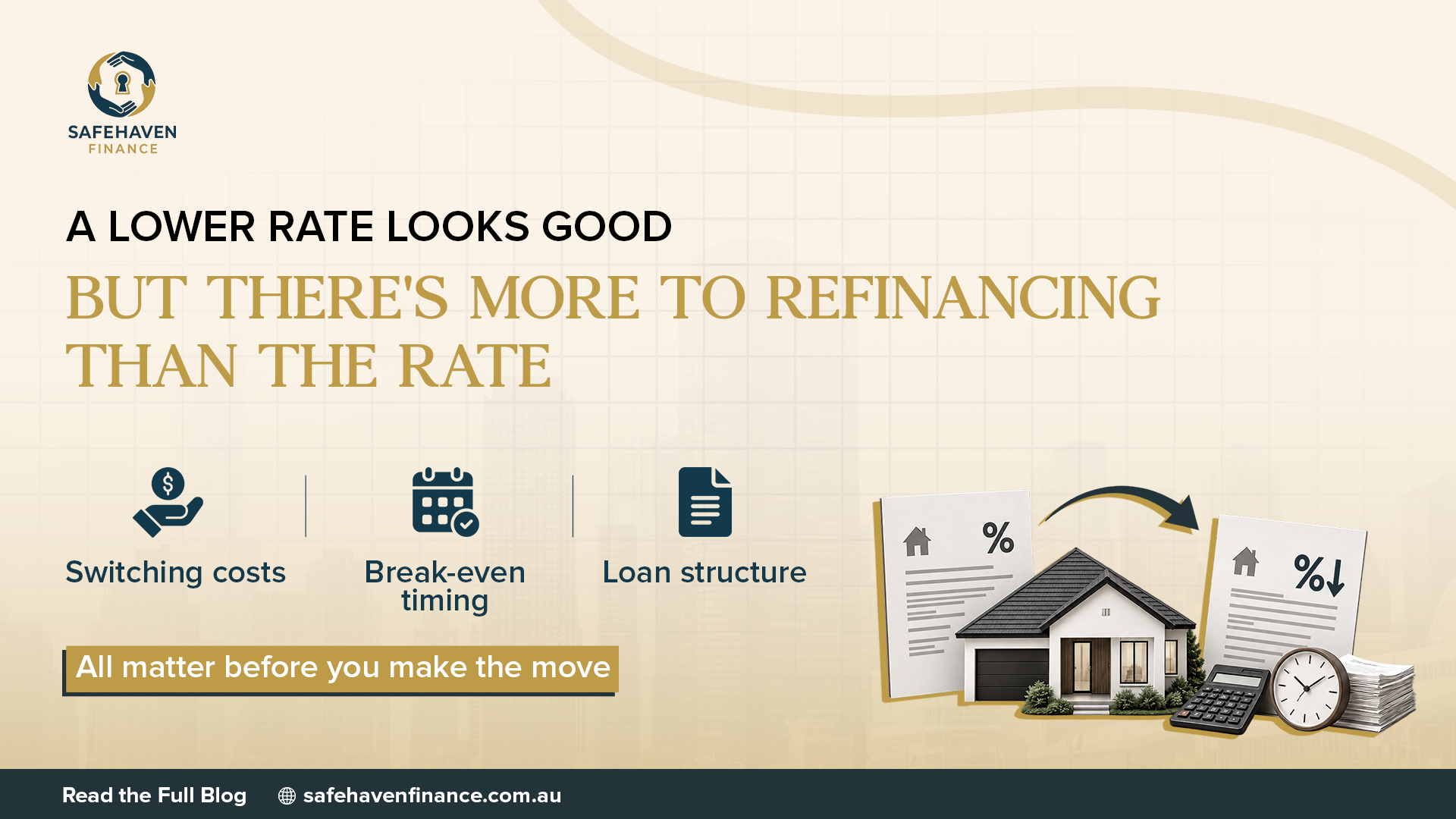
Refinancing a home loan involves more than simply comparing interest rates. Borrowers should also factor in the upfront costs associated with switching lenders or restructuring an existing mortgage.
Common refinancing costs in Australia may include:
• Loan discharge fees from your current lender
• Application or establishment fees for the new loan
• Property valuation fees
• Government registration charges
• Legal or settlement fees
• Fixed-rate break costs (if applicable)
These costs can range from a few hundred dollars to several thousand, depending on the lender and loan structure. Using a refinancing calculator, Australian borrowers can estimate their potential break-even point before proceeding with a refinance application.
Many borrowers also use a break-even refinancing calculator or refinancing calculator Australia tools to estimate whether the long-term savings outweigh the home loan refinance costs involved in switching.
Break-even point= Total refinancing costs ÷ Monthly interest savings. If you plan to stay in the property beyond that point, refinancing is financially positive. If not, it costs you money.
If total costs are $1,200 and the monthly savings are $300, you break even in four months. Every month after that is genuine savings. If your break-even point is 36 months and you are planning to sell or upgrade in two years, the refinance costs more than it saves, and that is a trap, not a solution.
When Refinancing Becomes a Trap
- Resetting to a fresh 30-year term
This is a common refinancing structure that may increase long-term interest costs if not carefully considered. Monthly repayments drop when the term resets, but total interest over the life of the loan rises significantly. The ’30-year trap’ means the total interest cost could rise by tens of thousands even if the rate is lower. The correct approach is to align the new loan term with the remaining years on your original mortgage or to commit to maintaining your current repayment amount regardless of the lower minimum.
- Exiting a fixed rate without checking break costs
Break costs on fixed-rate home loans can run to tens of thousands of dollars, depending on how far your fixed rate sits above current market rates and how much time remains on the term. Always request the exact break cost figure in writing from your lender before initiating any process. If the break cost exceeds your projected savings for the next 12–24 months, waiting until expiry is the financially rational choice.
- Consolidating debt without a repayment plan
Rolling high-interest debt into a mortgage is only a saving if you do not rebuild that debt afterwards, and only if the consolidated amount is not extended over 30 years unnecessarily. Clearing a $30,000 personal loan over 30 years instead of the remaining 4 years costs far more in interest, even at the lower mortgage rate. Consolidation requires a structured plan, not just a rate comparison.
- Refinancing purely to chase the lowest rate headline
The cheapest rate on the comparison site is not always the right loan. A lower rate with no offset account, restricted extra repayments, high annual fees, or a lender whose credit policy limits your ability to access equity later can cost more in lost flexibility than the rate saves in interest. In 2026, loan features and lender policy compatibility matter as much as the rate, particularly for borrowers who intend to grow a portfolio.
How Safe Haven Finance Approaches Every Refinance
At Safe Haven Finance, Payal Varma’s first step in any refinancing conversation is the break-even calculation, not the rate comparison. Once the numbers confirm a genuine case for switching, the analysis covers rate, features, loan term strategy, lender credit policy, and whether the structure serves the borrower’s next financial move, not just their current repayment. As an experienced home loan broker, Safe Haven Finance identifies where the real savings lie and is equally prepared to tell a client that staying and negotiating with the current lender is the better outcome. That honest approach is what close to 20 years of mortgage broker Australia and finance broking experience produces.
FAQ: Should I refinance now or wait for RBA rate cuts in 2026?
Answer: Rate movements remain uncertain in 2026, with major bank forecasts mixed. If your break-even point is short, waiting for future rate cuts may not always be the better move. A future rate cut may reduce both your current rate and a new refinance rate, so the gap may remain. Safe Haven Finance can model both scenarios with your specific figures.
Refinancing Is a Tool: Use It When the Numbers Say So
The best home loan refinancing decision in 2026 is not the one driven by a rate headline or a friend’s recommendation. It is the one driven by a clean break-even analysis, an honest look at the traps, and a clear view of how the new loan serves the next 3–5 years, not just the next repayment. That is the analysis Safe Haven Finance runs for every client before a single application is submitted.
If you are reviewing your current mortgage structure or considering refinancing in 2026, Safe Haven Finance can help you assess the numbers, loan structure, and long-term impact before making a decision.
To discuss your situation with Payal Varma, contact Safe Haven Finance on +61 433 564 936.
Follow Safe Haven Finance on Facebook, Instagram, and LinkedIn for regular refinancing guides, home loan tips, and Australian mortgage market updates.