Why Lender Policy Matters Just As Much As Your Income
Most borrowers start a home loan conversation by asking, “What interest rate can I get?” It’s an important question, but it isn’t always the first one that should be asked.
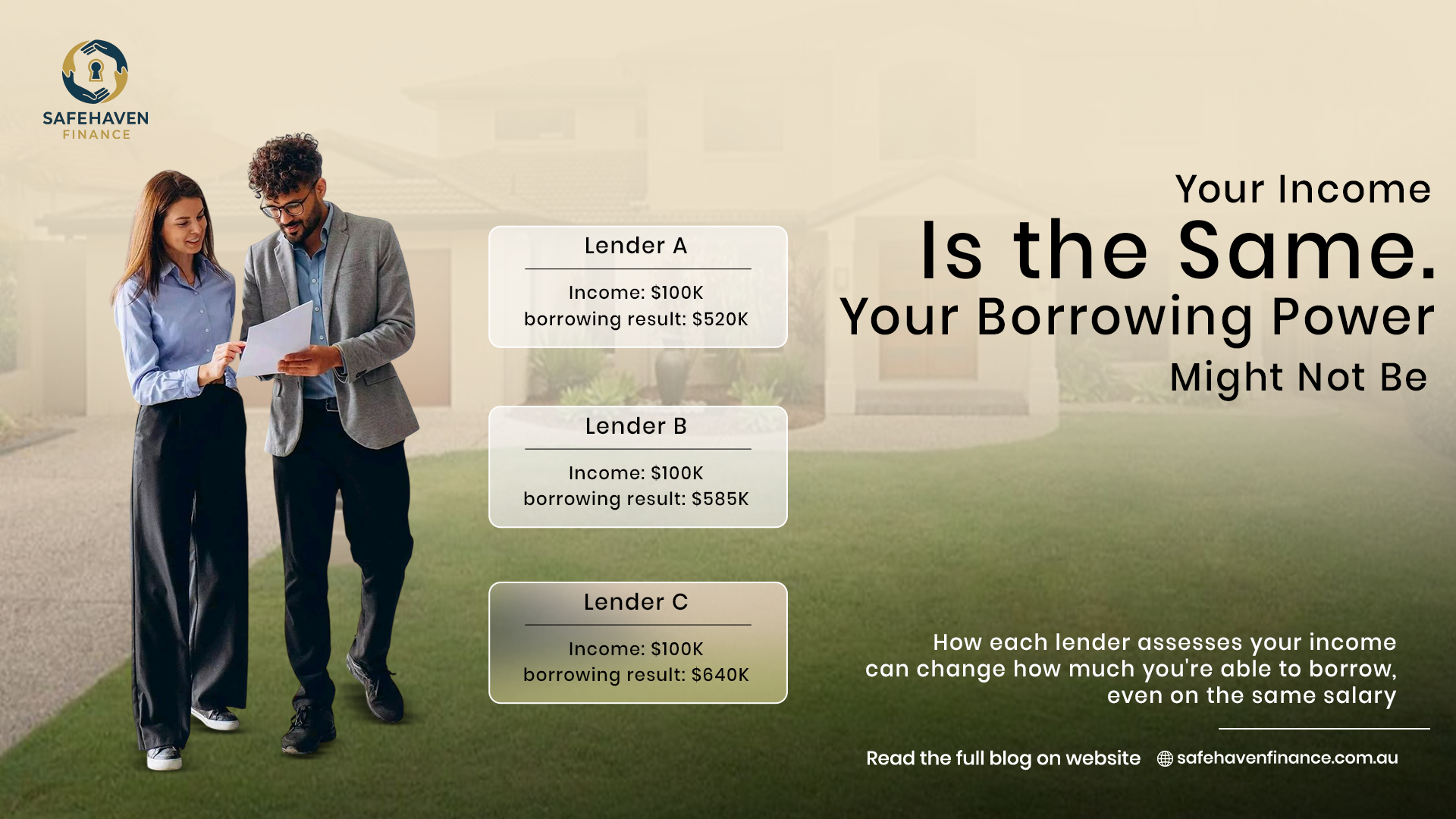
Before comparing rates, you need to know how a lender will assess your income, expenses, and existing commitments. That’s because two borrowers with the same income can have very different borrowing capacities depending on how their income is earned and how a lender’s policy treats it.
Two borrowers with the same headline income of $115,000 can receive different borrowing outcomes depending on how that income is earned and assessed. Different lender credit policies in Australia may treat salary, overtime, bonuses, commissions, or other income differently. This is why comparing policies across an accredited lender panel can matter just as much as comparing rates.
The Same Income, Different Lender, Different Outcome
Consider two borrowers, both earning $115,000 per year:
Borrower A is a PAYG employee earning a fixed salary of $115,000. Their income may be relatively straightforward to verify, although documentation and assessment requirements can still vary by lender.
Borrower B earns the same $115,000, but through a combination of base salary ($80,000), overtime ($20,000), and annual performance bonuses ($15,000). The overtime has been received consistently for three years. The bonus arrived this year and last year, but not the year before.
Borrower B may not have the full $115,000 recognised for servicing purposes by every lender. One lender may accept a higher proportion of the overtime and bonus based on its policy and the income history, while another may apply different treatment or require additional evidence. That difference can materially affect borrowing capacity in Australia even when the borrower’s actual earnings are the same.
Also Read: Inflation Remains Elevated: What It Means for Borrowers in 2026
Where Income Assessment Can Vary Most
Income assessment criteria can differ significantly where income is more variable or requires additional verification:
- Overtime and allowances: treatment depends on the lender, occupation, history, and consistency of income. For example, Westpac states that eligible frontline emergency-services applicants may have 100% of their overtime and allowances assessed as income, subject to conditions.
- Commission and bonus income: lenders may differ in the history required, the amount accepted, and whether income is averaged or shaded.
- Casual employment: Lenders can have different requirements around employment history and income verification. For example, ANZ’s current home loan checklist sets out different evidence requirements for casual employees, including payslips showing six months of continuous employment or alternative tax documentation in certain circumstances.
- Self-employed income: Business owners can see significant differences in how lenders assess their income. Some lenders may assess income using one financial year’s financials for eligible applicants, while others may require additional years of financial information or apply different treatment to business add-backs and adjustments.
- Rental income: lenders generally make allowances for expenses and potential income variability, but the amount recognised for servicing varies by lender.
- Foreign currency income: acceptance depends on lender policy, currency, country, evidence, and applicable income adjustments.
In every case above, the income itself is real. The variation is in how each lender assesses that income. This is not a loophole; it is how the lending market works. Different lenders have different risk appetites and different underwriting frameworks. A broker can compare lenders across their accredited panel to identify policies that appropriately recognise the borrower’s income and suit their overall financial position.
Income assessment criteria also sit alongside broader regulatory requirements. For APRA-regulated banks, the mortgage serviceability buffer remains at 3 percentage points above the loan rate. Lenders then apply their own policies when assessing income, expenses and other financial commitments.
2026 DTI Changes
Borrowing capacity can also be influenced by broader regulatory settings. Since February 2026, APRA has limited banks to having no more than 20% of new owner-occupied and investment lending at a debt-to-income ratio of six times or more, subject to specified exemptions.
Why the Lowest Rate Is Not Always the Best Match
A lender with a slightly lower advertised rate may not necessarily be the best fit if its lending criteria recognise less of the borrower’s eligible income. Conversely, a lender whose policy better suits the borrower may assess a different borrowing capacity.
The rate still matters, but it should be considered alongside borrowing capacity, fees, loan features and the lender’s assessment criteria rather than in isolation.
Your income doesn’t automatically translate into borrowing capacity. How a lender assesses that income matters. Payal Varma and the Safe Haven Finance team match each client’s income type to the lender whose credit policy treats it most favourably before any application is submitted.
Where Safe Haven Finance Fits In
With close to 20 years of banking, mortgage broking and lending experience and access to more than 50 lenders, Payal Varma and the Safe Haven Finance team compare how different lenders assess each client’s income and overall financial position before recommending suitable options.
Payal Varma and the Safe Haven Finance team compare how different lenders assess each client’s income and overall financial position before recommending suitable options.
Whether you’re buying, refinancing, or investing, Safe Haven Finance can help you compare lenders based on your individual circumstances, not just the advertised rate.
Book a free consultation at safehavenfinance.com.au or call +61 433 564 936. Also, you can follow us on Instagram, Facebook, and LinkedIn.
Frequently Asked Questions
Q: Why does the same income produce different borrowing capacity at different lenders?
Answer: Because lenders apply different credit policies to different income types, commission, bonus, casual earnings, and self-employed income may all be treated differently across the lender panel. This can result in different assessable income and borrowing capacities.
Q: Should I always choose the lender with the lowest advertised rate?
Answer: Not necessarily. Interest rate is important, but lender policy, borrowing capacity, fees, features, and eligibility should also be considered. The lowest advertised rate may not be the most suitable option for every borrower.
Q: Does lender credit policy change over time?
Answer: Yes. Lender policies can change over time in response to risk appetite, regulatory requirements, and internal lending criteria. Current policy matters more than a general reputation for flexibility.