Refinancing in 2026: How to Know If Switching Actually Saves You Money
If you’ve refinanced a mortgage before, you’ll remember the pitch: a lower rate, a cash-back offer, a promise of savings. What’s harder to find is a straight answer to the question that actually matters:
Will switching leave you financially better off once every cost is accounted for?
“As at September 2026, the RBA cash rate is 4.35%, following three increases earlier this year, that question is worth asking properly rather than assuming the answer is yes.
Why refinancing is back on borrowers’ minds
Rate movements this year have prompted many homeowners to check what they’re currently paying.
Nobody can tell you with certainty which way it will go next. What’s clear is that the gap between the best rates on the market and what long-standing borrowers are still paying on older loans can be significant, and that gap is usually where genuine savings sit.
The instinct to check your rate is a reasonable one. The mistake is stopping at the interest rate and skipping everything else that determines whether a switch is actually worth it.
What refinancing actually costs
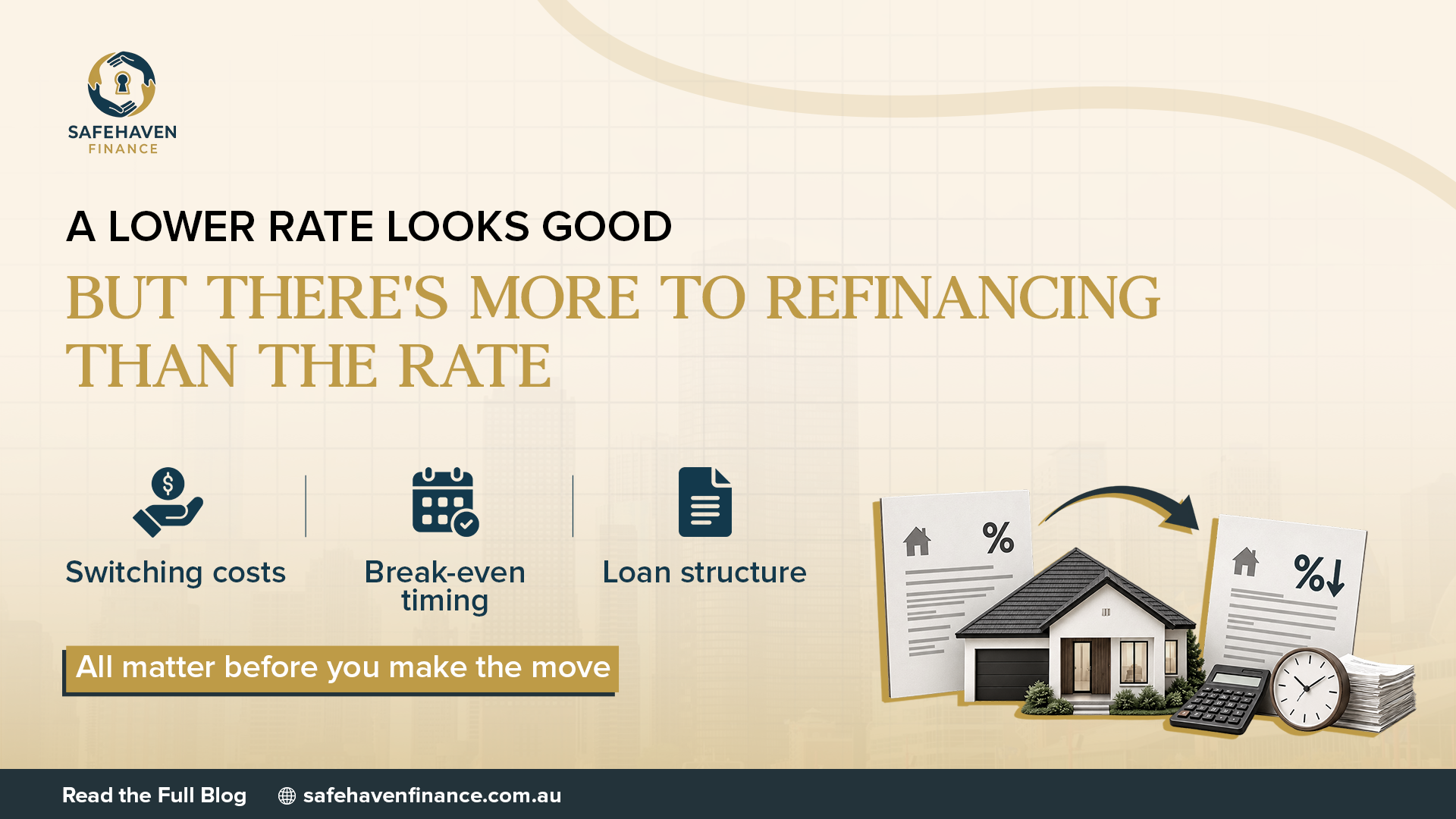
Refinancing isn’t free.
Early termination fees on most new residential loans have been prohibited since 1 July 2011, but discharge fees, new-loan fees, government registration charges, and fixed-rate break costs can still apply.
A discharge fee may apply when you close your existing loan. Your new lender may also charge application or settlement fees.
If you’re leaving a fixed-rate loan before the fixed period ends, a break cost may apply. The amount can vary significantly depending on the loan and market conditions.
Another important cost to check is Lenders Mortgage Insurance (LMI). If refinancing takes your loan above a lender’s acceptable LVR threshold, commonly 80% for a standard owner-occupied loan, LMI may become relevant. The exact threshold and requirements vary between lenders.
The lesson is simple: know the total switching cost before you commit.
The real test: does it break even?
The useful question isn’t:
“Is the new rate lower?”
It’s:
“How long will the repayment savings take to recover the switching costs?”
For example, if your new repayments save you $150 per month and switching costs $1,500, the simple break-even period is approximately 10 months.
“This is only a simple break-even calculation. If the new loan has different repayments, fees, loan terms or features, the overall financial benefit can be different.”
Break-even period = total switching costs ÷ monthly savings
If you’re planning to sell or refinance again before that point, the switch may not deliver the expected benefit.
Loan structure matters too. A lower rate attached to higher ongoing fees, fewer useful features or a less suitable offset structure may not be the better option overall.
Common mistakes worth avoiding
Two mistakes come up often. The first is relying on the advertised rate alone. The comparison rate can be a useful starting point because it incorporates the interest rate and most fees and charges. But it doesn’t capture every cost or account for features that may matter to you, such as offset functionality or repayment flexibility. The second is assuming that qualifying in principle means you’ll be approved. General eligibility, meeting a lender’s advertised criteria, is not the same as actual approval, which depends on your income, expenses, credit history, and the lender’s own serviceability assessment at the time you apply. Rules and appetite for risk vary between lenders, and they can shift with little notice.
The loan-term trap that can make a refinance look cheaper
One of the easiest ways for a refinance to look cheaper is to start the loan term again.
Imagine you’ve had your mortgage for eight years and have 22 years remaining. If you refinance and take out a new 30-year loan, your required monthly repayment may fall.
That doesn’t automatically mean you’re saving money.
You’re now potentially paying interest over a longer period. The lower monthly repayment can make the new loan look attractive, while the total interest paid over the life of the loan may be higher.
That’s why it’s important to compare more than the repayment. Look at the interest rate, loan balance, remaining term, repayment, fees and total interest cost.
If the new loan is suitable, you may also choose to keep repayments at a similar level rather than automatically extending the loan back to 30 years.
Where borrowing capacity fits in
Refinancing isn’t only about the rate.
It can also involve:
- Consolidating debt
- Accessing equity
- Changing loan structure
- Moving between fixed and variable rates
If you’re increasing the loan amount, consolidating debts or accessing equity, the application may be assessed differently from a simple like-for-like refinance. Your income, expenses, existing debts and the proposed loan structure can all affect the lender’s assessment.
What to consider before you switch
Start by reviewing your current interest rate, loan balance, and whether you’re in a fixed or variable term. Request an accurate discharge and break-cost figure from your existing lender rather than estimating. “Compare the costs and features of the new loan against your existing loan and consider a range of suitable lenders.” Then work out your break-even point against how long you intend to keep the loan.
Where a broker adds value
A broker can’t guarantee approval or savings, but can help you see the full cost of switching against the full range of options available, rather than the handful you’d find searching alone. That comparison, done properly, is usually what separates a genuine improvement from a lateral move.
If you’re weighing up whether refinancing makes sense for your situation, or want to understand your borrowing position before you decide, SafeHaven Finance offers a free 15-minute consultation to talk through your numbers and your options. You can reach us on +61 433 564 936 and follow us on Facebook, Instagram, and LinkedIn for more lending insights.